SpareParts365 – customized solutions for your industry
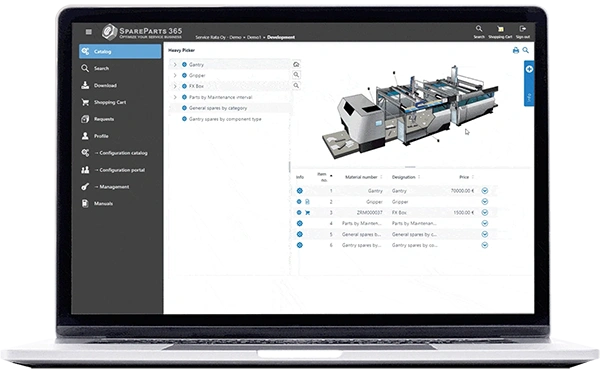

Computerized Maintenance Management Systems (CMMS)
CMMS are specialized software solutions that help companies plan, carry out and monitor their maintenance and repair processes.

What are Computerized Maintenance Management Systems (CMMS)?
Computerized Maintenance Management Systems (CMMS) are specialized software solutions that help organizations plan, execute and monitor their maintenance and repair processes. These systems offer comprehensive functions for managing maintenance orders, monitoring the condition of equipment and optimizing maintenance strategies.
The key features of a CMMS include:
- Maintenance planning and tracking: Automating the planning and tracking of maintenance orders.
- Asset management: the management and monitoring of assets and their maintenance history.
- Fault diagnosis: Tools for identifying and analysing faults.
- Spare parts management: managing spare parts and ordering them as required.
- Reporting: Preparing reports and analyses on the performance of maintenance processes.
Advantages of maintenance management systems
Implementing a CMMS brings numerous benefits for businesses:
- Improved efficiency: Automated processes and real-time data access improve the efficiency of maintenance work.
- Cost reduction: Operating costs can be reduced through preventive maintenance and optimized resource planning.
- Extending the service life of equipment: Regular and targeted maintenance increases the service life of machinery and equipment.
- Improved planning: Detailed planning and tracking functions enable maintenance orders to be coordinated more effectively.
- Improved safety: Reduced downtime and accidents through timely maintenance and diagnostics.
How do maintenance management systems work?
Maintenance management systems use a variety of technologies and methods to optimize maintenance processes:
- Data integration: CMMS integrate data from various sources, such as technical manuals, sensors and maintenance order histories.
- Automation: The software automates the planning, allocation and tracking of maintenance orders.
- Real-time monitoring: CMMS provide real-time monitoring of asset conditions and enable an immediate response to faults.
- Analysis and reporting: The systems generate detailed reports and analyses to assess and improve the performance of maintenance processes.
Examples of applications for maintenance management systems
Maintenance management systems are used in various industries:
- Industry: In the manufacturing sector, CMMS are used to manage production facilities in order to minimize downtime and maximize production output.
- Building management: Facility management teams use CMMS to manage the maintenance of building services, heating, ventilation and air-conditioning (HVAC) systems, and other infrastructure.
- Transport and logistics: In the transport sector, CMMS help to plan and carry out the maintenance of vehicle fleets in order to prevent downtime.
- Energy supply: CMMS support the maintenance and monitoring of power generation facilities to ensure a continuous and reliable energy supply.
Key functions and features of CMMS
- Maintenance planning: Planning of preventive and reactive maintenance orders.
- Asset management: the management of machinery, plant and other assets.
- Mobile support: Access to maintenance data and work orders via mobile devices for technicians in the field.
- Spare parts management: the administration and tracking of spare parts.
- Integration: Integration with other systems such as ERP and IoT for seamless data processing.
Outlook: Trends in maintenance management systems
- Artificial Intelligence (AI): AI-powered systems for predicting maintenance requirements and automating diagnostic processes.
- Internet of Things (IoT): IoT integration enables continuous monitoring of systems and the collection of real-time data for more precise maintenance strategies.
- Predictive maintenance: Maintenance based on data analysis and AI to predict and prevent potential faults.
- Cloud-based solutions: Cloud technologies offer flexible and scalable maintenance management solutions that can be accessed from anywhere.
Share:
Share this post
You might also be interested in...