SpareParts365 – customized solutions for your industry
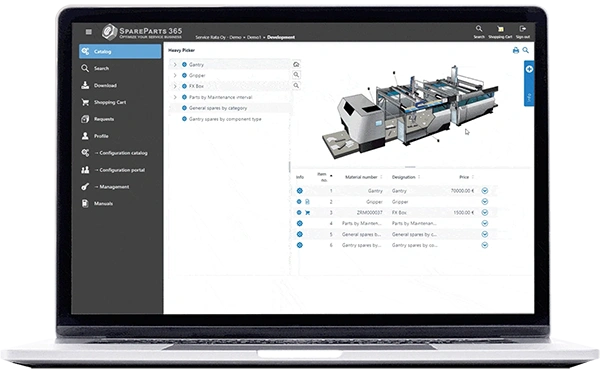

Service Information Systems (SIS): Documents and plans for maintenance and repair
SIS are specialized software solutions that provide comprehensive information and tools for the maintenance and repair of machinery, vehicles and equipment.

What are Service Information Systems (SIS)?
Service information systems (SIS) are specialized software solutions that provide comprehensive information and tools for the maintenance and repair of machinery, vehicles and equipment. These systems offer:
- Technical manuals: Comprehensive guides for maintenance and repair work.
- Troubleshooting tools: features for identifying and analysing problems.
- Maintenance records: Documentation of maintenance work carried out.
- Repair guides: Step-by-step instructions for resolving specific issues.
- Spare parts information: details of available spare parts, their part numbers and specifications.
Advantages of service information systems
The implementation of SIS brings numerous benefits for businesses and technicians:
- Improved efficiency: SIS enables quick access to the information you need and reduces the time required for maintenance and repairs.
- Error reduction: Precise diagnostic tools and detailed instructions help minimize incorrect decisions.
- Cost savings: Optimized maintenance and repair processes lead to lower operating costs.
- Improved documentation: All maintenance and repair work is systematically recorded, which improves traceability and quality assurance.
- Expandable features: Many SIS systems offer modular extensions such as remote maintenance and integration with other systems.
How do service information systems work?
Service information systems integrate various technologies and data sources to provide comprehensive maintenance and repair solutions:
- Data integration: SIS collects and integrates data from various sources, including technical manuals, repair guides and maintenance logs.
- Diagnostic tools: These provide diagnostic functions tailored to specific problems and enable the rapid identification of the causes of faults.
- User interface: The user interface is generally designed to be intuitive, making it easier to access information and use the tools.
- Reporting: SIS generates reports and logs on maintenance work carried out and the condition of the equipment.
Examples of applications for service information systems
Service information systems are used in various industries:
- Industry: In the manufacturing sector, SIS are used for the maintenance and repair of complex machinery, thereby reducing downtime and increasing productivity.
- Automotive industry: Garages use SIS for accurate vehicle diagnostics and repairs to ensure the quality of their services.
- Aviation: In the aviation industry, SIS play a crucial role in ensuring compliance with strict maintenance and safety standards by providing comprehensive maintenance procedures and protocols.
- Energy supply: When it comes to the maintenance of energy systems, SIS helps to reduce operating costs and improve operational efficiency.
Key functions and features of SIS
- Fault diagnosis: Tools for identifying and analysing problems.
- Interactive guides: Step-by-step instructions for troubleshooting.
- Spare parts management: Integration of spare parts catalogs for accurate parts ordering.
- Mobile support: Access to SIS via mobile devices for on-site maintenance work.
- Integrations: Integration with other systems such as ERP or CMMS for seamless data integration.
Outlook: Trends in Service Information Systems
- Artificial Intelligence (AI): AI will further improve fault diagnosis and maintenance forecasting by analyzing patterns and anomalies.
- Augmented Reality (AR): AR technologies could help to visualize maintenance instructions within the technician’s real-world environment.
- IoT integration: The Internet of Things (IoT) will further improve the real-time monitoring and diagnostics of devices.
- Cloud-based solutions: Cloud technologies enable access to SIS data from anywhere and promote collaboration between different teams.
Share:
Share this post
You might also be interested in...