SpareParts365 – customized solutions for your industry
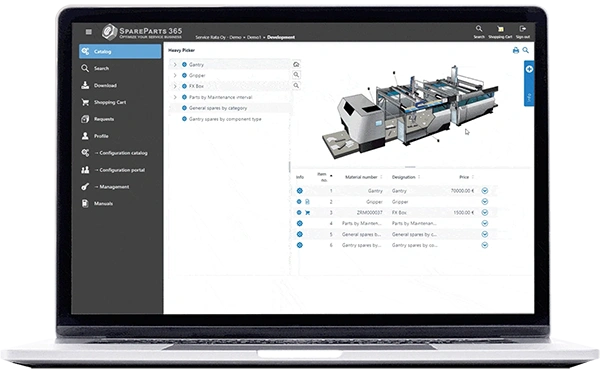

The relationship between service information systems and spare parts catalogs

What are Service Information Systems (SIS)?
Service information systems (SIS) are specialized platforms that provide comprehensive technical information on the maintenance and repair of machinery, vehicles and equipment. These systems include:
- Technical manuals: Detailed instructions on how to carry out maintenance and repair work.
- Troubleshooting: Tools for identifying and analyzing problems.
- Maintenance records: Records of maintenance work carried out and the results thereof.
- Repair guides: Step-by-step instructions for resolving specific issues.
What are spare parts catalogs?
Spare parts catalogs are comprehensive databases that provide information on available spare parts. They include:
- Part numbers: Unique identification numbers for each spare part.
- Part descriptions: Detailed descriptions of the spare parts.
- Prices: Costs for the individual parts.
- Availability: Information about stock levels and delivery times.
How are service information systems and spare parts catalogs linked?
- Integration and synergy: Service information systems and spare parts catalogs work hand in hand to enable efficient maintenance and repairs:
- Fault diagnosis and parts identification: When a problem is diagnosed, the SIS provides troubleshooting guidance. The spare parts catalog helps you find the exact spare part required to resolve the issue.
- Maintenance procedures and parts ordering: The SIS provides the necessary maintenance procedures, whilst the spare parts catalog lists the required parts. This enables the correct spare parts to be ordered quickly and accurately.
- Process optimisation: Combining the SIS with spare parts catalogs leads to more efficient maintenance and repair processes by providing all the necessary information in one place.
Benefits of integrating SIS and spare parts catalogs
- Reducing errors: By linking maintenance instructions directly to the relevant spare parts, incorrect orders and mix-ups are minimized.
- Increased efficiency: Technicians and engineers can access the information they need and order spare parts more quickly, thereby reducing the overall time taken for maintenance and repairs.
- Cost savings: Avoiding incorrect purchases and unnecessary orders through the precise identification of the required parts.
- Improved data management: Centralized data storage enables better oversight and management of maintenance and spare parts information.
Examples of use
- Industry: In the manufacturing sector, maintenance engineers can quickly identify the exact location and the parts required for machine repairs and place orders.
- Automotive industry: Garages can efficiently diagnose vehicle faults and accurately identify the correct parts for repairs or maintenance.
- Aviation: Aircraft maintenance staff use SIS for precise maintenance instructions and spare parts catalogs to ensure safety and efficiency in aircraft maintenance.
Future prospects: developments and trends
- Digital integration: Further development of digital platforms will enable even more seamless integration of SIS and spare parts catalogs.
- Artificial Intelligence (AI): AI can improve diagnostic tools and automatically suggest the best replacement parts.
- Augmented Reality (AR): AR technologies could help display maintenance instructions and spare parts information directly in the technician’s field of vision, thereby further improving efficiency.
Optimize your maintenance processes
Ready to improve your maintenance and repair processes?**
Discover how integrating service information systems and parts catalogs can optimize your operations. Contact us for a consultation or a demo of our innovative solutions.
Share:
Share this post
You might also be interested in...